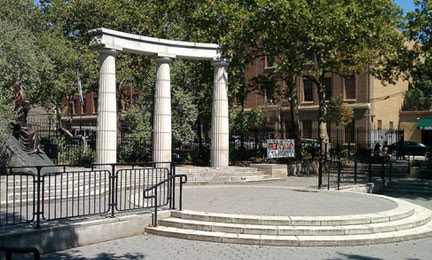
ANCIENT PSYCHE: A BILINGUAL BLOG (ENGLISH AND GREEK) ON PSYCHOPEDAGOGY-PSYCHOHISTORY-PSYCHOARCHAEOLOGY-ARCHAEOTHERAPEUTICS-ARCHAEONATUROPATHY-ARCHAEOCOUNSELING WITH A CLASSICAL, ΒΥΖΑΝΤΙΝΕ/ORTHDOX CHRISTIAN, MEDITERRANEAN, HELLENIC, HELLENIC-AMERICAN, AND AMERICAN EMPHASIS Photo: Athens Square, Astoria, NY (USA)
Monday, April 15, 2013
Βαγγέλης Παπαθανασίου - Vangelis, the great Greek composer whose music takes us to an epic journey through history, natural landscapes, around the globe and across the oceans to the subatomic world and the spacetime fabric to the stars and the worlds beyond the Milky Way and beyond the limits of our imagination!!!

Saturday, April 13, 2013
Friday, April 12, 2013
Wednesday, April 10, 2013
Monday, April 8, 2013
Saturday, April 6, 2013
Greek Parade on 5th Avenue in Manhattan, NY: old videos - Η παρέλαση στην 5η Λεωφόρο του Μανχάταν στη Νέα Υόρκη: στιγμιότυπα από παλαιότερες παρελάσεις
Friday, April 5, 2013

Thursday, April 4, 2013
Tuesday, April 2, 2013
Byzantine Settlement of Son Pereto (Mallorca)
Ruins of an early christian basilica from the 5th-7th centuries,with a baptistery having two cross-shaped baptismal basins,lots of tombs(around 20 of them excavated and specialists are estimating 200 more to be found),underground storage places for crops(carved in the rock beneath the site) etc. A lot more is still to be excavated by the Museum of History from Manacor (Mallorca).In the museum there is a superb burial mosaic from the tomb of Valeria (Baleria),supposedly an important priestess of the early christian community,and other mosaics which were decorating the floor of the ceremonial cloister.The museum is also exhibiting the altar stone of the basilica,a tombstone with inscription,a typical byzantine stonecross,etc. from the same age.
New Archaeological Discovery in Asia Minor (today's Turkey): Pluto's 'Gate to Hell' uncovered in Turkey
Source: http://science.nbcnews.com/_news/2013/04/01/17554605-plutos-gate-to-hell-uncovered-in-turkey?lite

Pluto's 'Gate to Hell'
uncovered
in Turkey

Francesco D'Andria
A digital illustration shows the ancient Plutonium, celebrated as the portal to the underworld in Greco-Roman mythology.
By Rossella LorenziDiscovery News
A “gate to hell” has emerged from ruins in southwestern Turkey,
Italian archaeologists have announced.
Known as Pluto's Gate -- Ploutonion in Greek, Plutonium in Latin --
the cave was celebrated as the portal to the underworld in Greco-Roman
mythology and tradition.
Historic sources located the site in the ancient Phrygian city of Hierapolis,
now called Pamukkale, and described the opening as filled with lethal
mephitic vapors.
PHOTOS: The Hunt for Lost Cities
“This space is full of a vapor so misty and dense that one can scarcely see the ground. Any animal that passes inside meets instant death,” the Greek geographer Strabo (64/63 BC -- about 24 A.D.) wrote.
“I threw in sparrows and they immediately breathed their last and fell,” he added.
Announced this month at a conference on Italian archaeology in Istanbul,
Turkey, the finding was made by a team led by Francesco D'Andria,
professor of classic archaeology at the University ofSalento.
D'Andria has conducted extensive archaeological research at the World
Heritage Site of Hierapolis. Two years ago he claimed to discover there
the tomb of Saint Philip, one of the 12 apostles of Jesus Christ.
Founded around 190 B.C. by Eumenes II, King of Pergamum
(197 B.C.-159 B.C.), Hierapolis was given over to Rome in 133 B.C.
ANALYSIS: Tomb of Jesus' Apostle Found In Turkey?
The Hellenistic city grew into a flourishing Roman city, with temples, a
theater and popular sacred hot springs, believed to have healing properties.
“We found the Plutonium by reconstructing the route of a thermal spring.
Indeed, Pamukkale' springs, which produce the famous white travertine
terraces, originate from this cave,” D'Andria told Discovery News.
Featuring a vast array of abandoned broken ruins, possibly the result of
earthquakes, the site revealed more ruins once it was excavated. The
archaeologists found Ionic semi columns and, on top of them, an inscription
with a dedication to the deities of the underworld -- Pluto and Kore.
D'Andria also found the remains of a temple, a pool and a series of steps
placed above the cave -- all matching the descriptions of the site in ancient
sources.
“People could watch the sacred rites from these steps, but they could not
get to the area near the opening. Only the priests could stand in front of the
portal,” D'Andria said.
According to the archaeologist, there was a sort of touristic organization at
the site. Small birds were given to pilgrims to test the deadly effects of the cave, while hallucinated priests sacrificed bulls to Pluto.
The ceremony included leading the animals into the cave, and dragging them
out dead.
Top 10 Animal Mysteries and Myths Explained
“We could see the cave's lethal properties during the excavation. Several birds died as they tried to get close to the warm opening, instantly killed by the carbon dioxide fumes,” D'Andria said.
Only the eunuchs of Cybele, an ancient fertility goddess, were able to enter the hell gate without any apparent damage.
“They hold their breath as much
as they can,” Strabo wrote, adding
that their immunity could have been
due to their "menomation," “divine providence”
or “certain physical powers that are antidotes against the vapor.”
According to D'Andria, the site was a famous destination for rites
of incubation. Pilgrims took the waters in the pool near the temple,
slept not too far from the cave and received visions and prophecies,
in a sort of oracle of Delphi effect. Indeed, the fumes coming from the
depths of Hierapoli's phreatic groundwater produced hallucinations.
“This is an exceptional discovery as it confirms and clarifies the information
we have from the ancient literary and historic sources,” Alister Filippini,
a researcher in Roman history at the Universities of Palermo, Italy, and
Cologne, Germany, told Discovery News.
Fully functional until the 4th century A.D., and occasionally visited during
the following two centuries, the site represented “an important pilgrimage
destination for the last pagan intellectuals of the Late Antiquity,” Filippini said.
During the 6th century A.D., the Plutonium was obliterated by the Christians.
Earthquakes may have then completed the destruction.
D'Andria and his team are now working on the digital reconstruction of the site.
Monday, April 1, 2013
Subscribe to:
Posts (Atom)